
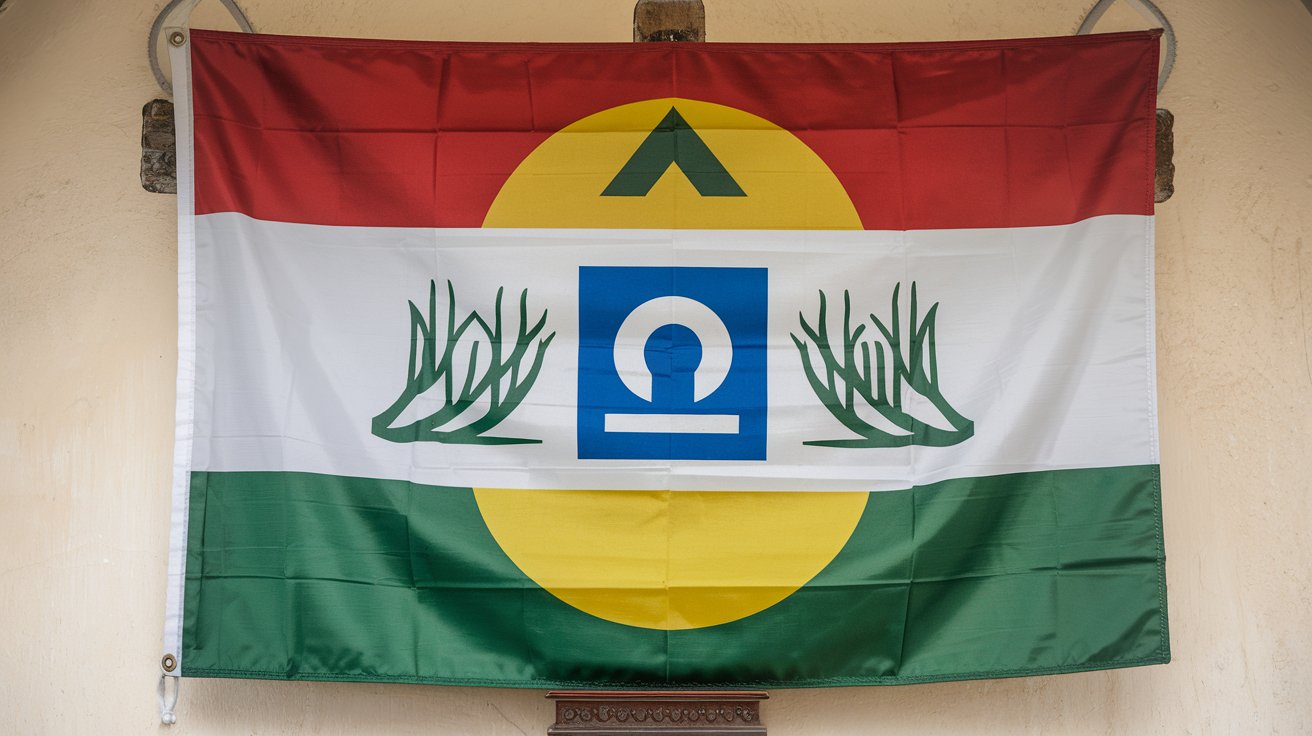
The Assyrian flag represents one of the world’s oldest continuous civilizations, serving as a powerful symbol for the Assyrian people across the United States and globally. This distinctive banner features a golden circle radiating four pointed stars against a blue and red background, embodying thousands of years of cultural heritage. For the estimated 400,000 Assyrians living in the United States in 2026, this flag connects modern communities to their ancient Mesopotamian roots while representing their ongoing struggle for recognition and cultural preservation.
What Is the Assyrian Flag and Its Official Design
The Assyrian flag features a distinctive design created in 1968 by George Atanus, an Assyrian artist based in Chicago. The flag consists of a white background with a golden circle at its center, from which four triangular rays extend toward the corners. A blue stripe runs along the top edge, while a red stripe borders the bottom, creating a tricolor effect that holds deep symbolic meaning for the Assyrian nation. This design has become the universal symbol for Assyrians worldwide, representing their unified identity despite geographic dispersion.
The flag’s dimensions follow a standard 2:3 ratio, though variations exist for ceremonial purposes. The golden circle at the center represents Shamash, the ancient Mesopotamian sun god, symbolizing light and enlightenment. The four pointed stars extending from the circle signify the four Assyrian empires that once dominated the ancient Near East, while also representing the four directions from which Assyrians have been dispersed throughout history. In 2026, this flag flies at Assyrian cultural centers, churches, and community gatherings throughout the United States, particularly in areas with significant Assyrian populations like Chicago, Detroit, and Turlock, California.
Understanding Assyrian Origins and Identity
The question wat is de assyrische afkomst or what is Assyrian origin traces back to ancient Mesopotamia, in the region now encompassing parts of northern Iraq, southeastern Turkey, northwestern Iran, and northeastern Syria. Assyrians are descendants of the ancient Assyrian Empire that flourished from approximately 2500 BCE to 609 BCE, making them one of the world’s oldest continuously existing ethnic groups. The Assyrian people maintained their distinct identity through language, religion, and cultural traditions despite numerous invasions and occupations throughout history.
Modern Assyrians predominantly practice Christianity, with most belonging to various Eastern Christian denominations including the Chaldean Catholic Church, Assyrian Church of the East, Syriac Orthodox Church, and Syriac Catholic Church. Their native language, Neo-Aramaic, directly descends from the ancient Aramaic spoken throughout the Near East for millennia. In the United States, Assyrian communities have established strong cultural institutions that preserve their heritage while integrating into American society. The 2026 census estimates indicate that Michigan, California, and Illinois host the largest Assyrian populations in America, with many families having immigrated following periods of persecution in their ancestral homelands.
The Deep Symbolism Behind the Assyrian Flag Colors
The betekenis van de assyrische vlag or meaning of the Assyrian flag extends far beyond aesthetic choices, with each color carrying profound historical and cultural significance. The white background symbolizes peace and the Assyrian people’s aspirations for a peaceful existence and recognition of their rights. The blue stripe at the top represents the Tigris and Euphrates rivers, the lifeblood of ancient Mesopotamian civilization where Assyrian culture first flourished. This blue also symbolizes tranquility and the heavens, connecting the earthly Assyrian nation to divine protection.
The red stripe along the bottom signifies courage, sacrifice, and the blood shed by Assyrians throughout history in defense of their faith and identity. This red holds particular significance given the numerous persecutions Assyrians have endured, including the Seyfo genocide of 1915 and more recent attacks by extremist groups in the Middle East. The golden circle and stars represent not only the ancient sun deity but also enlightenment, knowledge, and the intellectual contributions Assyrians made to human civilization, including advances in mathematics, astronomy, and writing systems. The four-pointed design specifically honors the ancient cities of Assur, Nineveh, Arbel, and Nimrud, which served as capitals of Assyrian empires at various points in history.
Assyrians: Who They Are and Their Global Presence
When examining wie zijn de Assyriërs or who are the Assyrians, it’s essential to understand them as a distinct ethnic group rather than merely a religious community. Assyrians possess their own language, cultural traditions, historical narrative, and national consciousness that distinguishes them from neighboring Middle Eastern populations. Despite lacking a recognized nation-state, approximately 3 to 5 million Assyrians live worldwide in 2026, with significant populations in Iraq, Syria, Iran, Turkey, and throughout the Western diaspora, particularly in the United States, Sweden, Germany, and Australia.
The Assyrian diaspora in the United States began in earnest during the late 19th and early 20th centuries, with major waves following the Assyrian genocide of World War I, the Simele massacre of 1933, political instability in Iraq and Iran during the 1970s-1980s, and most recently following the rise of ISIS in 2014. In 2026, American Assyrian communities maintain vibrant cultural institutions including language schools, cultural centers, churches, and professional organizations. Cities like Chicago have entire neighborhoods where Assyrian businesses thrive, Neo-Aramaic is spoken daily, and traditional festivals are celebrated. These communities work actively to preserve their heritage while contributing to American society in fields ranging from medicine and engineering to business and education.
Distinguishing Between Aramaic and Assyrian Identity
The verschil aramees en assyrisch or difference between Aramaic and Assyrian often confuses those unfamiliar with Middle Eastern ethnography. Aramaic refers to a language family that was once the lingua franca of the Near East, spoken by various peoples including ancient Arameans, Jews, and others. Assyrian, however, denotes a specific ethnic identity belonging to descendants of the ancient Assyrian Empire who speak Neo-Aramaic dialects as their mother tongue. While all modern Assyrians speak forms of Aramaic, not all Aramaic speakers are ethnically Assyrian.
This distinction became politically significant during the 20th century as various Christian communities from the Middle East debated their ethnic classifications. Some groups identify as Aramean or Syriac rather than Assyrian, though they share linguistic and religious similarities. These naming controversies reflect complex historical, theological, and political considerations. In the United States, most members of these communities use Assyrian as an umbrella term for practical purposes, though organizations representing different denominational backgrounds may prefer specific terminology. The 2026 academic consensus among historians and anthropologists recognizes Assyrians as the legitimate ethnic descendants of ancient Mesopotamian civilizations, with their Neo-Aramaic language serving as one of many markers of this continuous identity. Understanding these distinctions helps appreciate the Assyrian flag’s significance as a unifying symbol for a community with diverse internal perspectives.
Assyrian Women and Their Role in Cultural Preservation
Assyrische vrouwen or Assyrian women have historically played crucial roles in preserving cultural identity, language transmission, and community cohesion. In traditional Assyrian society, women served as primary educators of children, ensuring the continuation of Neo-Aramaic language and cultural practices across generations. They maintained household religious practices, prepared traditional foods, and transmitted oral histories and folk traditions. In the diaspora context of 2026 America, Assyrian women balance traditional cultural values with modern American lifestyles, often serving as bridges between generations.
Contemporary Assyrian women in the United States have achieved remarkable success in education and professional fields while maintaining strong connections to their heritage. Many pursue higher education at rates exceeding national averages and work in healthcare, education, business, and technology sectors. Assyrian women’s organizations throughout the United States focus on cultural preservation, charitable work supporting Assyrians in the Middle East, and advocacy for human rights. They organize cultural festivals where the Assyrian flag prominently features, teach traditional dance and music, and maintain social networks that strengthen community bonds. The balance between cultural preservation and American integration varies among individuals and families, but Assyrian women consistently demonstrate resilience in maintaining their distinct identity while fully participating in American society.
The Assyrian Flag in American Cultural Celebrations
Throughout the United States, the Assyrian flag appears prominently at cultural celebrations that mark important dates in the Assyrian calendar and American holidays. The most significant commemoration is Assyrian Martyrs Day on August 7th, which remembers victims of the Seyfo genocide and other persecutions. During these solemn observances in cities like Chicago, Detroit, Phoenix, and San Diego, the Assyrian flag flies at half-mast alongside American flags, symbolizing both mourning and resilience. These events typically feature traditional music, poetry readings in Neo-Aramaic, and speeches by community leaders advocating for recognition of historical atrocities.
More celebratory events showcase the Assyrian flag during Akitu, the Assyrian New Year celebrated on April 1st according to the ancient Mesopotamian calendar. These festivals transform parks and community centers into vibrant displays of Assyrian culture, with the flag serving as a central symbol. Traditional dances like khigga are performed by groups wearing traditional costumes, while booths offer Assyrian cuisine and handicrafts. The flag also appears at Assyrian conventions, which rotate between major American cities annually and attract thousands of participants who celebrate their heritage through sports tournaments, cultural competitions, and social gatherings. In 2026, these events increasingly attract second and third-generation Assyrian Americans seeking to reconnect with their roots, with the flag serving as a powerful visual anchor to their ancestral identity.
Historical Connections: From Ancient Empires to Modern Symbol
The Assyrian flag deliberately incorporates symbols from the ancient empires that once dominated the Near East. The ancient Assyrian Empire reached its zenith during the Neo-Assyrian period (911-609 BCE), when it became the largest empire the world had yet seen, stretching from Egypt to the Persian Gulf. The empire’s capital cities—Assur, Nineveh, Nimrud, and Khorsabad—were architectural marvels featuring massive palaces, libraries, and temples. The famous Library of Ashurbanipal in Nineveh contained thousands of cuneiform tablets that preserved Mesopotamian literature, including the Epic of Gilgamesh, making it effectively the world’s first systematically organized library.
The four-pointed star design on the Assyrian flag directly references the winged sun disk that appeared frequently in ancient Assyrian art, representing divine authority and royal power. Ancient Assyrian monuments featured lamassu—winged bulls or lions with human heads—that guarded palace entrances and symbolized protective power. These artistic motifs find modern expression in Assyrian cultural centers throughout the United States, where reproductions of ancient reliefs and sculptures create connections between past and present. The flag’s symbolism reminds modern Assyrians that they descend from a civilization that made fundamental contributions to human development, including innovations in irrigation, military organization, administrative systems, and artistic expression. This historical pride strengthens contemporary Assyrian identity and provides cultural confidence for communities navigating life in diaspora.
Assyrian Flag Protocol and Respectful Display
Within Assyrian communities in the United States, specific protocols govern the respectful display and handling of the Assyrian flag, similar to practices surrounding national flags. The flag should be displayed prominently at Assyrian churches, cultural centers, and community organizations, often alongside the American flag to demonstrate dual loyalty to heritage and adopted homeland. When both flags appear together, the Assyrian flag typically occupies a position of equal height and prominence, reflecting the community’s pride in both identities. During processions and parades, the flag should be carried upright and never allowed to touch the ground, showing respect for what it represents.
At private homes, many Assyrian families display the flag during cultural celebrations, holidays, and times of crisis affecting Assyrians in the Middle East. The flag appears on car mirrors, clothing, jewelry, and social media profiles as expressions of cultural pride. Some protocols suggest the flag should not be used for purely commercial purposes unless proceeds benefit Assyrian causes or communities. During moments of tragedy, such as terrorist attacks targeting Assyrians or natural disasters affecting ancestral homelands, the flag unites the diaspora in shared grief and solidarity. Educational programs in Assyrian community schools teach younger generations about proper flag etiquette, ensuring these traditions continue. In 2026, digital versions of the flag proliferate on social media, where Assyrians worldwide use it as a profile frame or backdrop to assert their identity and connect with the global Assyrian community.
Hessana and Assyrian Cultural Expressions
Hessana represents a traditional Assyrian folk dance performed in circular formations at weddings, festivals, and community celebrations throughout the United States. This dance brings together participants of all ages who hold hands or link arms while moving in synchronized steps to traditional Assyrian music. The Assyrian flag often appears prominently at venues where Hessana is performed, creating a visual backdrop that reinforces cultural identity. The dance itself embodies community unity and continuity, values the flag symbolizes. Different regional Assyrian communities have variations of Hessana with unique steps and musical accompaniments, reflecting the diverse origins of American Assyrian populations.
During major Assyrian celebrations in cities like Modesto, California or Skokie, Illinois, Hessana performances can involve hundreds of participants forming massive circles that wind through parks or parking lots. Traditional musicians play the zurna (a woodwind instrument) and davul (a large drum), creating rhythmic music that energizes dancers. These events serve crucial social functions, allowing young Assyrians to meet potential partners within their cultural community and providing older generations opportunities to transmit cultural knowledge. The presence of the Assyrian flag at these gatherings creates a sense of national identity despite the absence of a physical homeland. Photography and videography of these events, inevitably featuring the flag, circulate through social media, strengthening connections between Assyrian communities across different American cities and creating digital archives of cultural practices for future generations.
Comparing Assyrian Identity Symbols with Other Flags
The question is er een vlag met de shahada erop or is there a flag with the shahada on it refers to flags of several Muslim-majority nations that feature the Islamic declaration of faith, such as Saudi Arabia and the Taliban flag. This question highlights the religious dimension that distinguishes identity symbols in the Middle East. Unlike flags featuring the shahada, the Assyrian flag represents an ethnic-religious identity where Christianity forms an integral component but doesn’t dominate the symbolism. The Assyrian flag uses ancient pre-Islamic symbols like the sun disk, connecting to Mesopotamian heritage predating Abrahamic religions.
This distinction matters because Assyrian identity fundamentally differs from the primarily religious identities represented by flags featuring Islamic declarations. While Assyrians are predominantly Christian, their identity rests on ethnic lineage, language, and historical continuity rather than religious affiliation alone. Other Middle Eastern Christian communities have their own symbols—Lebanese Maronites sometimes use the cedar flag, Egyptian Copts use crosses with specific designs—but the Assyrian flag uniquely references ancient imperial symbols, asserting a continuous national identity spanning millennia. In the American context, this distinction helps Assyrians explain their identity to neighbors unfamiliar with Middle Eastern ethnic complexity. The flag serves as a visual teaching tool, sparking conversations about the region’s diversity beyond the oversimplified religious narratives that dominate American media coverage of the Middle East.
Educational Resources and Assyrian Flag Information
For those seeking comprehensive information, Assyrische vlag wikipedia or Assyrian flag Wikipedia provides detailed documentation of the flag’s history, design specifications, and symbolic meanings in multiple languages. However, the most authoritative sources come from Assyrian cultural organizations themselves. In the United States, institutions like the Assyrian American National Federation, Assyrian Academic Society, and Assyrian Universal Alliance maintain websites with educational materials about Assyrian culture, history, and symbolism. These organizations offer resources in both English and Neo-Aramaic, making information accessible to both community members and interested outsiders.
Many American universities with significant Assyrian student populations have established Assyrian student associations that provide educational programming about Assyrian history and culture. These groups often display the Assyrian flag at campus cultural festivals alongside informational materials explaining its significance. Academic research on Assyrian topics has expanded considerably in 2026, with several universities offering courses on Mesopotamian civilization that include modules on modern Assyrian communities. Museums like the Oriental Institute at the University of Chicago feature extensive exhibits on ancient Assyria, providing historical context that enriches understanding of modern Assyrian identity symbols. Digital resources have proliferated, with YouTube channels, podcasts, and social media accounts dedicated to Assyrian history and culture, many featuring explanations of the flag’s symbolism. These diverse educational resources help preserve Assyrian heritage while making it accessible to younger generations growing up in diaspora and to non-Assyrians interested in this ancient yet living civilization.
Related video about assyrische vlag
This video complements the article information with a practical visual demonstration.
What you should know
What does the golden circle on the Assyrian flag represent?
The golden circle at the center of the Assyrian flag represents Shamash, the ancient Mesopotamian sun god, symbolizing light, enlightenment, and divine guidance. The four pointed rays extending from this circle signify the four ancient Assyrian empires and the four cardinal directions from which Assyrians have been dispersed throughout history. This design element connects modern Assyrian identity directly to their ancient Mesopotamian heritage, reminding the community of their civilization’s contributions to human development. The golden color specifically represents the value and preciousness of Assyrian cultural heritage and the enlightenment their ancestors brought to the ancient world through innovations in writing, mathematics, and governance.
How many Assyrians live in the United States in 2026?
Approximately 400,000 Assyrians reside in the United States as of 2026, making it one of the largest Assyrian populations outside the Middle East. Major concentrations exist in Michigan (especially Detroit and its suburbs), California (particularly Turlock, Modesto, and San Diego), Illinois (Chicago area), Arizona (Phoenix), and New Jersey. These communities maintain vibrant cultural institutions including churches, language schools, and cultural centers where the Assyrian flag is prominently displayed. The American Assyrian population has grown significantly since the 1970s due to immigration waves following political instability in Iraq, Iran, Syria, and Turkey, with the most recent significant wave occurring after 2014 when ISIS targeted Assyrian communities in Iraq and Syria.
What is the difference between Assyrian and Aramean identity?
Assyrian identity refers to descendants of the ancient Assyrian Empire who maintain ethnic continuity through language, culture, and historical consciousness. Aramean identity, claimed by some Syriac-speaking Christians, emphasizes descent from ancient Arameans rather than Assyrians. Both groups speak Neo-Aramaic dialects and predominantly belong to Eastern Christian churches, creating significant overlap. The distinction involves complex historical interpretations and denominational affiliations, with some Syriac Orthodox members preferring the Aramean designation while Church of the East members typically identify as Assyrian. In practical terms within the United States, most members of these communities use Assyrian as an umbrella term for cultural and political unity, though individuals may have personal preferences. The Assyrian flag generally represents all Syriac-speaking Christians from Mesopotamia regardless of specific identity labels.
Why do the colors of the Assyrian flag matter?
Each color on the Assyrian flag carries profound historical and cultural significance. The white background symbolizes peace and the Assyrian aspiration for recognition and safety. The blue stripe represents the Tigris and Euphrates rivers that sustained ancient Mesopotamian civilization, while also symbolizing tranquility and divine protection. The red stripe signifies courage and the blood sacrificed by Assyrians throughout history, particularly during genocides and persecutions. The golden sun and stars represent enlightenment, divine guidance, and the intellectual achievements of ancient Assyrian civilization. Together, these colors create a visual narrative of Assyrian history—from ancient glory through suffering to hopes for peaceful recognition—making the flag a powerful symbol that connects past, present, and future for Assyrian communities worldwide.
When was the Assyrian flag created and by whom?
The Assyrian flag was designed in 1968 by George Atanus, an Assyrian artist living in Chicago, Illinois. Atanus created the design to provide a unified symbol for Assyrians worldwide who lacked a national flag despite maintaining distinct ethnic identity. The flag gained widespread acceptance throughout Assyrian diaspora communities and is now universally recognized as the national symbol of the Assyrian people. The timing of its creation coincided with growing Assyrian political consciousness and organizational development in Western diaspora communities during the 1960s and 1970s. Since then, the flag has appeared at Assyrian gatherings, cultural events, political demonstrations, and community institutions across the United States and globally, becoming an essential element of modern Assyrian identity expression and a rallying point for cultural preservation and political advocacy.
What role does the Assyrian flag play in community identity in America?
In the United States, the Assyrian flag serves as a crucial unifying symbol for a geographically dispersed ethnic community. It appears prominently at churches, cultural centers, festivals, and private homes, providing a visual marker of Assyrian presence and pride. The flag helps second and third-generation Assyrian Americans connect with their heritage, offering a tangible symbol around which cultural identity can coalesce. During community crises—such as terrorist attacks targeting Assyrians in the Middle East—the flag becomes a rallying point for solidarity and advocacy. It distinguishes Assyrians from other Middle Eastern groups in the multicultural American landscape, asserting their unique identity. Educational use of the flag in community schools and cultural programs helps transmit historical knowledge and ethnic pride to younger generations, ensuring cultural continuity despite assimilation pressures in American society.
| Assyrian Flag Element | Symbolic Meaning | Cultural Significance |
|---|---|---|
| Golden Circle & Stars | Ancient sun deity Shamash, four Assyrian empires, four directions of dispersion | Connects modern identity to ancient Mesopotamian civilization and intellectual heritage |
| Blue Stripe | Tigris and Euphrates rivers, tranquility, divine protection | Links community to ancestral homeland geography and spiritual foundations |
| Red Stripe | Courage, sacrifice, blood of martyrs | Honors persecution survivors and maintains collective memory of historical suffering |
| White Background | Peace, hope for recognition and safety | Expresses aspirations for peaceful coexistence and cultural preservation |
| Overall Design (1968) | Unified national symbol for dispersed ethnic group | Provides visual identity marker for 400,000+ US Assyrians and worldwide diaspora |