
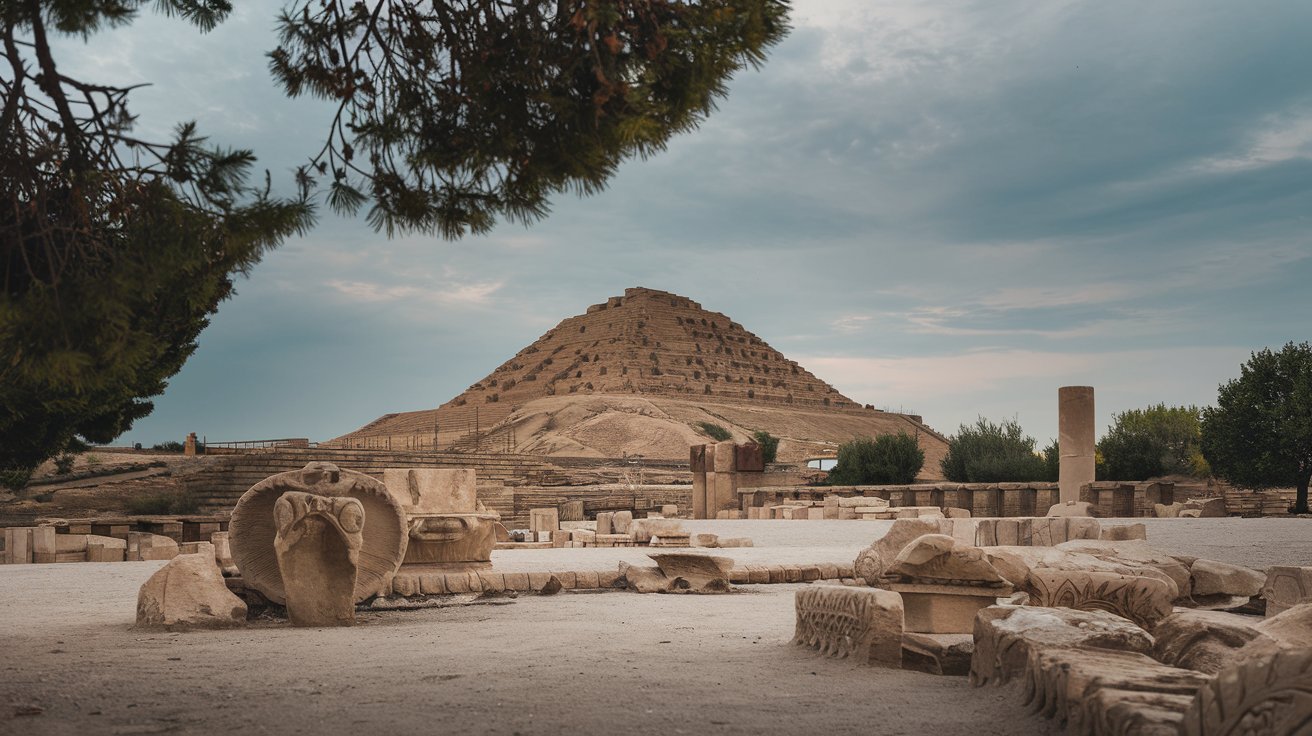
Mesopotamia, often called the cradle of civilization, was the ancient region located between the Tigris and Euphrates rivers in what is now modern-day Iraq, Kuwait, Turkey, and Syria. This fertile land, whose name literally means land between rivers in Greek, gave birth to the world’s first cities, writing systems, and complex governments around 3500 BCE. Understanding Mesopotamian civilization provides essential insights into the foundations of modern society, from law codes to mathematical concepts still used today.
What is Mesopotamia and Where is It Located
Mesopotamia refers to the historical region situated in the eastern Mediterranean, bounded by the Tigris River to the east and the Euphrates River to the west. Today, this area primarily corresponds to modern Iraq, with portions extending into southeastern Turkey, northeastern Syria, and northwestern Iran. The region’s geography created a natural corridor stretching approximately 300 miles from the Persian Gulf northward to the mountains of eastern Turkey.
The fertile crescent encompassed Mesopotamia as its eastern anchor, where annual river flooding deposited nutrient-rich silt that enabled agriculture to flourish. This geographical advantage allowed ancient peoples to develop permanent settlements rather than maintain nomadic lifestyles. The region consisted of two distinct areas: Upper Mesopotamia in the north with rolling plains and reliable rainfall, and Lower Mesopotamia in the south featuring marshlands and requiring sophisticated irrigation systems to support farming.
As of 2026, archaeological sites across Iraq continue to reveal new insights about ancient Mesopotamian life. The Iraqi government has reopened several historical sites to international researchers, including portions of ancient Babylon located about 50 miles south of Baghdad. These locations provide tangible connections to civilizations that emerged over 5,000 years ago and fundamentally shaped human development.
The Meaning and Significance of Mesopotamia
The term Mesopotamia derives from the ancient Greek words mesos (middle) and potamos (river), literally translating to land between rivers. This name perfectly captures the region’s defining geographical feature: its position between two major waterways that provided life-sustaining resources. Ancient inhabitants called the region by various names depending on their specific location, including Sumer, Akkad, Babylonia, and Assyria during different historical periods.
The significance of Mesopotamia extends far beyond its etymology. This region earned recognition as the cradle of civilization because it witnessed humanity’s first experiments with urban living, centralized government, and written communication. The Mesopotamian innovations included the wheel, the plow, bronze metallurgy, and the first known legal code under Hammurabi. These developments occurred between approximately 3500 BCE and 500 BCE, establishing patterns that subsequent civilizations would follow and adapt.
Major Civilizations and Empires of Ancient Mesopotamia
Mesopotamia served as home to multiple successive civilizations, each contributing unique innovations while building upon previous achievements. The region’s history spans thousands of years, with power shifting among various peoples and cultures that controlled the fertile territory.
The Sumerians: First Mesopotamian Civilization
The Sumerians established the world’s first civilization in southern Mesopotamia around 3500 BCE, creating city-states like Uruk, Ur, Lagash, and Eridu. They invented cuneiform writing around 3200 BCE, initially for record-keeping but eventually for literature, including the Epic of Gilgamesh. Sumerian society developed the first schools, called edubbas, where scribes learned the complex writing system. They also created the sexagesimal number system (base-60) that gave us 60-minute hours and 360-degree circles still used in 2026. Archaeological evidence from 2025-2026 excavations reveals that Sumerian cities housed populations exceeding 50,000 people, remarkable for the Bronze Age.
The Akkadian Empire and Babylonian Kingdoms
Around 2334 BCE, Sargon of Akkad conquered the Sumerian city-states and established the first empire in world history, the Akkadian Empire. This marked the beginning of Semitic dominance in Mesopotamia. The Akkadian language eventually replaced Sumerian for daily communication, though Sumerian remained important for religious and scholarly purposes. Following the Akkadian collapse around 2154 BCE, the region fragmented until the rise of Babylon under Hammurabi around 1792 BCE. The Babylonian Empire reached its zenith with the famous Code of Hammurabi, containing 282 laws carved into a stone stele, now housed in the Louvre Museum in Paris. Later, the Neo-Babylonian Empire under Nebuchadnezzar II (605-562 BCE) constructed the legendary Hanging Gardens of Babylon, though archaeological confirmation remains elusive as of 2026.
The Assyrian Empire: Military Powerhouse
The Assyrians, originating from northern Mesopotamia around the city of Ashur, built history’s most formidable ancient military empire. The Neo-Assyrian Empire (911-609 BCE) expanded across the entire Near East, from Egypt to Persia, using advanced siege warfare technology and efficient administrative systems. The Assyrian capital moved multiple times, with Nineveh serving as the final and most magnificent capital under kings like Sennacherib and Ashurbanipal. The Library of Ashurbanipal in Nineveh housed over 30,000 clay tablets, preserving Mesopotamian literature and knowledge. Recent digital reconstruction projects in 2026 have created virtual reality experiences allowing people worldwide to explore these ancient Assyrian palaces.
Mesopotamian Innovations and Contributions to Civilization
The peoples of Mesopotamia pioneered numerous technological and intellectual advances that continue influencing modern life. Their innovations emerged from practical needs but evolved into sophisticated systems that subsequent civilizations adopted and refined.
Writing Systems and Literature
The invention of cuneiform writing around 3200 BCE represents one of humanity’s most significant achievements. Scribes pressed reed styluses into wet clay tablets, creating wedge-shaped marks that could represent words, syllables, or concepts. This writing system enabled record-keeping, contracts, royal decrees, and eventually literary works. The Epic of Gilgamesh, composed around 2100 BCE, stands as the world’s oldest known literary work, exploring themes of friendship, mortality, and the search for meaning that resonate in 2026. Modern scholars have translated thousands of tablets, revealing everything from medical prescriptions to mathematical calculations, providing unprecedented insights into daily Mesopotamian life.
Mathematics, Astronomy, and Science
Mesopotamian mathematicians developed the sexagesimal system and understood sophisticated concepts including place value, fractions, and basic algebra. They calculated square roots, solved quadratic equations, and created multiplication tables still reflected in our 60-second minutes and 360-degree circles. Babylonian astronomers meticulously recorded celestial movements, identifying planetary patterns and predicting eclipses with remarkable accuracy. They divided the sky into constellations and created the zodiac system. Their astronomical observations, recorded on thousands of tablets called astronomical diaries, provide modern scientists with historical climate and celestial data spanning centuries. In 2026, researchers continue analyzing these records to understand long-term astronomical cycles and ancient environmental conditions.
Law, Government, and Social Organization
The Code of Hammurabi (circa 1750 BCE) established one of history’s first comprehensive legal frameworks, addressing everything from trade disputes to family law. While not the absolute oldest law code, it remains the most complete and well-preserved. The code’s principle of proportional justice influenced subsequent legal systems, though its literal interpretation of an eye for an eye differs from modern justice concepts. Mesopotamian governments developed bureaucratic systems with tax collection, census taking, and administrative hierarchies. Kings ruled as representatives of the gods, maintaining order through both religious authority and military power. Social stratification included nobles, priests, merchants, artisans, farmers, and slaves, with limited but documented social mobility.
Religion and Mythology in Mesopotamian Culture
Mesopotamian religion featured a complex polytheistic system with thousands of deities governing different aspects of life and nature. The pantheon included major gods like Anu (sky god), Enlil (storm god), Enki (water god), and Inanna/Ishtar (goddess of love and war). Each city maintained patron deities worshiped in massive temple complexes called ziggurats, stepped pyramidal structures that dominated city skylines.
Religious beliefs permeated every aspect of Mesopotamian society. Priests held significant political power, managing temple estates that controlled substantial agricultural land and wealth. Religious festivals marked the agricultural calendar, and divination practices helped rulers make important decisions. The Mesopotamians believed the gods created humans to serve them, and maintaining proper religious observance ensured prosperity and divine favor. Mythological texts like the Enuma Elish (Babylonian creation myth) and the Epic of Atrahasis (flood narrative) influenced later religious traditions, including elements that appear in biblical accounts. Modern scholars in 2026 continue discovering religious texts that illuminate the spiritual worldview of these ancient peoples.
Daily Life and Social Structure in Ancient Mesopotamia
Ordinary Mesopotamian citizens lived lives centered around agricultural cycles, family obligations, and religious observances. Most people were farmers working land owned by temples, the king, or wealthy landowners, though some owned small plots. Urban residents worked as artisans, merchants, scribes, or laborers. Houses were typically constructed from mud brick, with wealthier families occupying larger structures featuring interior courtyards.
The Mesopotamian diet consisted primarily of barley bread, dates, vegetables, and fish, with meat reserved for special occasions. Beer served as a staple beverage, brewed by women and consumed daily by adults and children. Education remained limited to elite families who could afford scribal training, a lengthy process taking years to master cuneiform’s hundreds of signs. Women’s roles varied by social class and time period, with some women owning property, engaging in business, and even serving as priestesses, though men dominated political and military spheres. Recent archaeological analysis from 2025-2026 has revealed that social mobility existed to a limited degree, with successful merchants sometimes achieving significant wealth and status.
The Fall of Mesopotamian Civilizations
The decline of Mesopotamian dominance occurred gradually through multiple conquests and environmental challenges. The Neo-Babylonian Empire fell to the Persian Empire under Cyrus the Great in 539 BCE, marking the end of native Mesopotamian rule. Subsequently, the region passed through Persian, Greek (Alexander the Great), Parthian, and eventually Arab control after 637 CE.
Environmental factors contributed significantly to Mesopotamia’s decline. Centuries of irrigation without proper drainage caused soil salinization, reducing agricultural productivity. Political instability disrupted the maintenance of complex irrigation systems essential for supporting large urban populations. Climate changes during the late Bronze Age brought periods of drought that stressed agricultural systems. By the medieval period, the great cities of ancient Mesopotamia lay abandoned, their ziggurats crumbling into tells (artificial hills) that dotted the landscape. Modern Iraq inherited this rich archaeological heritage, though conflicts in the late 20th and early 21st centuries damaged numerous sites. As of 2026, international preservation efforts work to protect and study remaining Mesopotamian ruins, with digital archiving ensuring that knowledge survives even if physical sites face threats.
Mesopotamian Legacy in the Modern World
The influence of Mesopotamian civilization extends directly into 2026 through numerous aspects of contemporary life. Our division of hours into 60 minutes and circles into 360 degrees stems from Babylonian mathematics. The seven-day week originated from Mesopotamian astronomy, with each day named for celestial bodies. Legal concepts including written contracts, property rights, and codified punishments trace ancestry to Mesopotamian precedents like Hammurabi’s Code.
Modern architecture reflects Mesopotamian innovations, particularly in brick construction techniques and the concept of monumental public buildings. The ziggurat influenced stepped pyramid designs across ancient cultures. Agricultural practices including large-scale irrigation, crop rotation, and grain storage systems began in Mesopotamia. Even the wheel, invented around 3500 BCE in Mesopotamia for pottery making before transportation applications, remains fundamental to modern technology. In 2026, museums across the United States, including the Metropolitan Museum of Art in New York and the Oriental Institute in Chicago, house significant Mesopotamian artifact collections that educate millions about this foundational civilization. University programs continue training new generations of Assyriologists who decipher tablets and reconstruct ancient Mesopotamian culture, ensuring these contributions remain recognized and studied.
Studying Mesopotamia in 2026: Resources and Opportunities
For those interested in learning more about ancient Mesopotamia, 2026 offers unprecedented access to information and educational resources. Major universities including Yale, Harvard, and the University of Pennsylvania offer Assyriology programs and online courses. Digital humanities projects like the Cuneiform Digital Library Initiative provide free access to thousands of translated tablets. The British Museum’s online collection features interactive 3D models of Mesopotamian artifacts, allowing detailed examination from anywhere.
Several excellent books published in recent years provide accessible introductions to Mesopotamian history, including works by scholars like Gwendolyn Leick, Paul Kriwaczek, and Marc Van De Mieroop. For visual learners, documentary series and YouTube channels dedicated to ancient history offer engaging content about Mesopotamian civilizations. Archaeological tourism to Iraq has cautiously resumed, with guided tours visiting sites like Babylon and Ur for those seeking firsthand experiences. The Iraqi government and UNESCO have partnered on preservation initiatives, ensuring that future generations can connect with humanity’s earliest urban civilization.
Related video about mesopotamië
This video complements the article information with a practical visual demonstration.
Frequently Asked Questions
How was Mesopotamia also known and what does it mean?
Mesopotamia was commonly known as the land between two rivers or the cradle of civilization. The name Mesopotamia comes from ancient Greek, combining mesos (middle) and potamos (river), referring to its location between the Tigris and Euphrates rivers. Ancient inhabitants used different names depending on the time period and specific region, including Sumer, Akkad, Babylonia, and Assyria. This region earned the cradle of civilization designation because it witnessed humanity’s first cities, writing systems, and complex governments emerging around 3500 BCE.
What is the oldest empire in the world from Mesopotamia?
The Akkadian Empire, founded by Sargon of Akkad around 2334 BCE, is recognized as the world’s first true empire in recorded history. Sargon conquered the independent Sumerian city-states and unified them under centralized control, creating an empire that stretched across Mesopotamia. Before this, the Sumerian civilization (circa 3500 BCE) represented the world’s first civilization but consisted of independent city-states rather than a unified empire. The Akkadian Empire established precedents for imperial administration, military conquest, and cultural integration that influenced all subsequent empires throughout history.
What was the capital of Mesopotamia throughout history?
Mesopotamia never had a single permanent capital because different civilizations controlled the region over thousands of years. Major capitals included Uruk and Ur during the Sumerian period (3500-2000 BCE), Akkad under Sargon’s empire (2334-2154 BCE), Babylon during multiple Babylonian kingdoms (1792-539 BCE), and Nineveh as the Assyrian capital (911-609 BCE). Babylon served as the most famous and longest-lasting capital, particularly under Hammurabi and later Nebuchadnezzar II. Each city functioned as a political, religious, and economic center during its period of dominance, with power shifting based on military conquests and political changes.
Which modern country was formerly Mesopotamia?
The modern country of Iraq occupies most of the territory that was ancient Mesopotamia. However, the historical region also extended into parts of present-day Kuwait, southeastern Turkey, northeastern Syria, and northwestern Iran. Iraq’s name itself derives from an Arabic term, but the country sits atop the heartland where Sumerian, Babylonian, and Assyrian civilizations flourished. Major archaeological sites including Babylon, Ur, Nineveh, and Uruk lie within Iraq’s borders. As of 2026, Iraq continues working with international organizations to preserve and study these ancient Mesopotamian sites that represent humanity’s earliest urban civilizations.
What major inventions came from Mesopotamia?
Mesopotamia produced numerous foundational inventions including cuneiform writing (circa 3200 BCE), the wheel (circa 3500 BCE), the plow, bronze metallurgy, and the sailboat. Mesopotamians developed the sexagesimal (base-60) number system still used for time and angle measurement, created the first legal codes, and pioneered irrigation agriculture. They invented beer brewing, created the first schools, developed astronomical calendars, and wrote the earliest known literature. The concept of urbanization itself—cities with specialized labor, centralized government, and monumental architecture—originated in Mesopotamia. These innovations fundamentally shaped subsequent human development across all civilizations.
How can I visit or learn about Mesopotamian sites in 2026?
In 2026, several options exist for exploring Mesopotamian heritage. Archaeological tourism to Iraq has cautiously resumed, with organized tours visiting restored sites like Babylon and Ur under security protocols. Major museums worldwide, including the British Museum, Louvre, and Metropolitan Museum of Art, display extensive Mesopotamian collections. Virtual reality experiences and online 3D models allow digital exploration of reconstructed ancient cities. Universities offer online courses in ancient Near Eastern history, and numerous books provide accessible introductions to Mesopotamian civilization. Documentary series and educational YouTube channels present engaging visual content. Digital archives like the Cuneiform Digital Library Initiative offer free access to thousands of translated tablets for serious researchers.
| Mesopotamian Achievement | Historical Period | Modern Legacy |
|---|---|---|
| Cuneiform Writing | 3200 BCE – Sumerian | Foundation of written communication and record-keeping |
| Code of Hammurabi | 1750 BCE – Babylonian | Basis for codified legal systems worldwide |
| Sexagesimal Number System | 3000 BCE – Sumerian | 60-minute hours, 360-degree circles used in 2026 |
| The Wheel | 3500 BCE – Mesopotamian | Transportation and machinery foundation |
| Irrigation Agriculture | 5000 BCE – Early Mesopotamian | Large-scale farming techniques still employed |
| Astronomical Observations | 2000 BCE – Babylonian | Calendar systems and celestial navigation |