
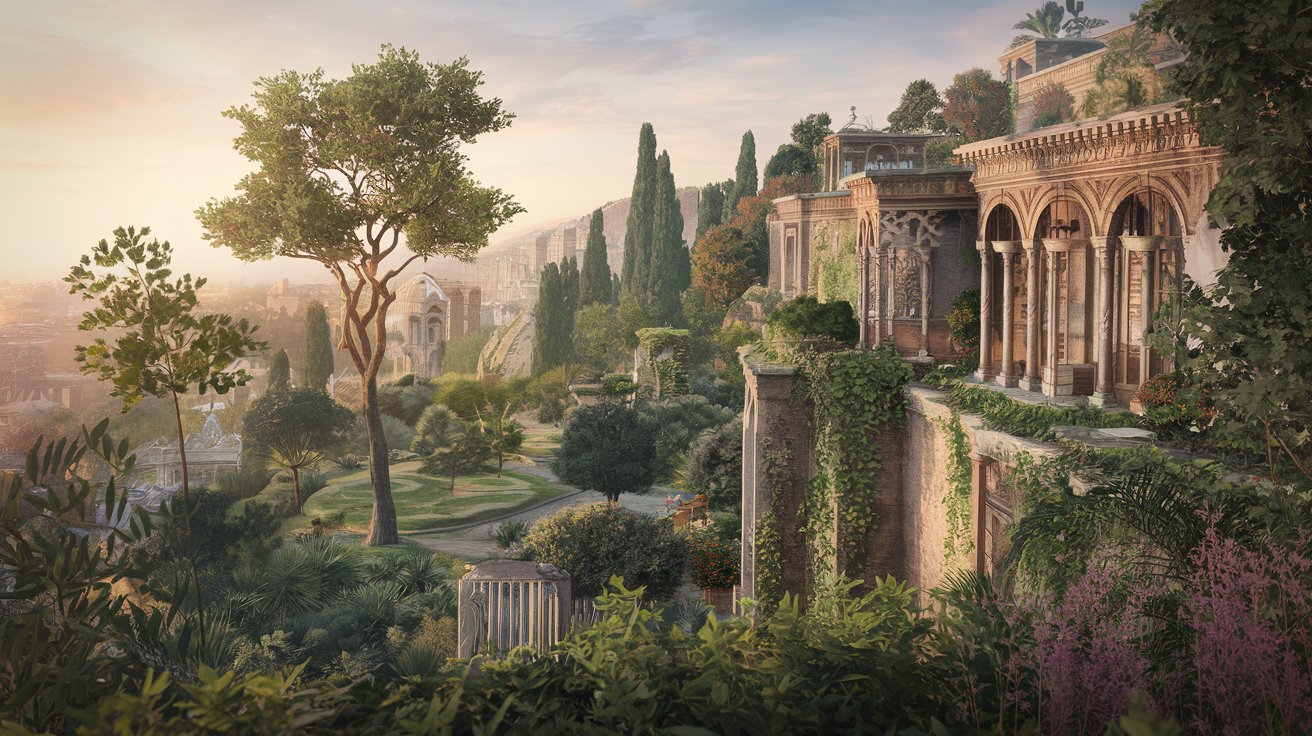
The Hanging Gardens of Babylon remain one of history’s most captivating enigmas, listed among the Seven Wonders of the Ancient World yet shrouded in mystery. While ancient texts describe terraced gardens cascading with exotic plants near modern-day Iraq, archaeological evidence has never conclusively proven their existence. This comprehensive guide explores what happened to these legendary gardens, where they supposedly stood, and what scholars in 2026 believe about this architectural marvel that has fascinated humanity for over two millennia.
What Were the Hanging Gardens of Babylon
The Hanging Gardens of Babylon were described by ancient Greek and Roman writers as an extraordinary terraced garden structure built in ancient Mesopotamia, near present-day Baghdad, Iraq. According to classical accounts, these gardens featured an intricate system of elevated terraces that created the illusion of a lush, green mountain rising from the flat Mesopotamian plains. Greek historian Strabo described gardens reaching heights of approximately 75 feet, with each terrace supporting large trees, exotic flowers, and various plant species transported from across the ancient world.
The engineering required for such a structure would have been remarkable for its time, around 600 BCE. Ancient texts suggest the gardens utilized an advanced irrigation system that lifted water from the Euphrates River through a series of screws and chains operated by human or animal power. This sophisticated hydraulic technology would have been necessary to sustain the gardens in Babylon’s arid climate, where annual rainfall in the region averages less than 10 inches. The terraces were reportedly constructed with stone columns supporting platforms layered with reeds, asphalt, tiles, and lead sheets to prevent water leakage into lower levels.
The Nebuchadnezzar II Connection
King Nebuchadnezzar II, who ruled Babylon from approximately 605 to 562 BCE, is traditionally credited with commissioning the Hanging Gardens. According to the most popular legend, he built this architectural wonder for his wife, Queen Amytis of Media, who longed for the green hills and valleys of her homeland. As the Median princess married to secure a political alliance, Amytis reportedly suffered from homesickness in the flat, dusty landscape of Babylon, prompting her husband to recreate the mountainous terrain she missed.
Nebuchadnezzar II’s reign represented the Neo-Babylonian Empire’s golden age, during which the city of Babylon underwent massive construction projects. Historical records confirm he rebuilt the city walls, constructed the famous Ishtar Gate with its brilliant blue glazed bricks, and expanded the palace complex. However, despite extensive cuneiform inscriptions detailing his building achievements, there is no direct mention of the Hanging Gardens in Babylonian records, which creates one of history’s most perplexing omissions. This silence has led scholars in 2026 to question whether the gardens existed in Babylon at all or if they’ve been misattributed to the wrong location or ruler.
The King Sennacherib Alternative Theory
In recent decades, a compelling alternative theory has emerged suggesting that the Hanging Gardens were actually located in Nineveh, not Babylon, and were built by Assyrian King Sennacherib around 700 BCE—nearly a century before Nebuchadnezzar II. Dr. Stephanie Dalley from Oxford University has championed this theory since the early 2000s, presenting evidence that has gained significant traction among archaeologists by 2026. Her research points to Sennacherib’s own inscriptions describing elaborate gardens with advanced irrigation systems that match classical descriptions of the Hanging Gardens of Babylon.
Sennacherib’s palace at Nineveh, near modern Mosul in northern Iraq, featured extensive gardens watered by an impressive aqueduct system stretching over 50 miles. Archaeological excavations have uncovered remnants of these waterworks, including the remains of the Jerwan Aqueduct built around 690 BCE. Ancient reliefs from Sennacherib’s palace depict gardens with trees on elevated structures, closely resembling descriptions of the legendary hanging gardens. This theory suggests that later Greek writers may have confused or conflated Nineveh with the more famous Babylon, or that the term Babylon was used broadly to refer to the entire Mesopotamian region rather than the specific city.
What Did the Gardens Actually Look Like
Based on ancient descriptions from writers like Diodorus Siculus, Strabo, and Philo of Byzantium, the Hanging Gardens would have presented a breathtaking spectacle unlike anything else in the ancient world. The structure supposedly consisted of vaulted terraces built upon cube-shaped pillars, creating a series of elevated platforms that resembled a green pyramid or theater. Each level was reportedly large enough to accommodate rows of large trees with root systems extending 11 feet or more, requiring substantial soil depth and structural support.
The gardens were described as measuring approximately 400 feet on each side and rising to heights comparable to modern seven-story buildings. Ancient accounts mention that the terraced structure was hollow, with rooms and chambers beneath the gardens where the complex irrigation machinery operated. The top terrace featured a reservoir that supplied water to the entire system through channels and drains. Visitors approaching from the flat plains would have witnessed what appeared to be a verdant mountain covered in vegetation—palms, cypresses, fruit trees, flowering plants, and vines cascading down the sides, creating the hanging effect that gave the gardens their name.
The plant diversity would have been extraordinary for its time, featuring species from across the Neo-Babylonian Empire and beyond. In 2026, botanical historians estimate that the gardens could have contained date palms native to Mesopotamia, cedars from Lebanon, roses from Persia, and various aromatic herbs. The visual impact would have been amplified by the contrast between the lush greenery and the yellowish-brown brick architecture typical of Babylonian construction, creating an oasis effect in the desert landscape that ancient writers found worthy of inclusion among the Seven Wonders of the Ancient World.
Where Were the Hanging Gardens Located
The traditional location of the Hanging Gardens is believed to be ancient Babylon, situated approximately 50 miles south of modern Baghdad, Iraq, near the present-day city of Hillah. If they existed in Babylon, the gardens would likely have been part of the royal palace complex on the eastern bank of the Euphrates River. German archaeologist Robert Koldewey, who excavated Babylon from 1899 to 1917, identified a structure with unusual vaulted foundations near the Southern Palace that he believed might have supported the gardens.
Koldewey discovered a building with thick walls capable of supporting significant weight, along with a well system that could have provided water for irrigation. However, this identification remains controversial, as the structure’s size and orientation don’t perfectly match ancient descriptions. Modern archaeological surveys using ground-penetrating radar and other non-invasive techniques have continued to search for definitive evidence, but as of 2026, no conclusive proof has emerged from the Babylon site. The area has suffered from both natural erosion and human conflict, with damage occurring during various wars in Iraq, making archaeological work challenging.
The alternative Nineveh location, approximately 250 miles north of Babylon near present-day Mosul, presents stronger physical evidence. The site of Sennacherib’s palace shows clear remains of extensive water engineering projects, including canals, aqueducts, and garden terraces. Archaeological evidence from Nineveh includes stone reliefs depicting garden scenes and inscriptions describing Sennacherib’s horticultural achievements. However, the Nineveh theory requires accepting that ancient Greek writers either misidentified the location or used Babylon as a general term for Mesopotamian wonders, complicating efforts to definitively establish where these legendary gardens actually stood.
What Happened to the Hanging Gardens of Babylon
If the Hanging Gardens existed in Babylon as traditionally believed, they likely met their end through a combination of natural disasters, warfare, and systematic neglect. Ancient Babylon suffered multiple invasions following the fall of the Neo-Babylonian Empire to the Persians in 539 BCE. When Alexander the Great conquered Babylon in 331 BCE, Greek accounts suggest the gardens still existed, though possibly in declining condition. However, after Alexander’s death in 323 BCE in Babylon itself, the city’s importance gradually diminished as the Seleucid Empire moved its capital to Seleucia on the Tigris.
Earthquakes represent the most commonly cited cause for the gardens’ disappearance. The Mesopotamian region sits in a seismically active zone, and several major earthquakes are documented in ancient records. A significant earthquake occurring sometime after the first century BCE could have collapsed the terraced structures and damaged the sophisticated irrigation systems beyond repair. Without constant maintenance and water supply, any surviving vegetation would have quickly perished in Babylon’s harsh desert climate, where summer temperatures regularly exceed 110°F.
Additionally, the Euphrates River changed its course over centuries, which would have disrupted water access essential for maintaining the gardens. By the second century CE, Babylon had largely been abandoned, with its population dispersing to other cities. The site fell into ruin, and valuable building materials were gradually removed for use in other construction projects—a common practice known as quarrying ancient sites. By medieval times, Babylon existed only as a legendary name, with travelers unable to identify which ruins might have once supported the magnificent Hanging Gardens described in ancient texts.
Do the Hanging Gardens Still Exist Today
As of 2026, the Hanging Gardens of Babylon do not exist in any recognizable form, and their exact location remains unconfirmed. Unlike other ancient wonders such as the Great Pyramid of Giza, which still stands, no definitive archaeological remains have been identified as belonging to the gardens. The site of ancient Babylon is now an archaeological park in Iraq, where visitors can see reconstructed portions of the Ishtar Gate and city walls, but no remnants of the legendary gardens are on display or definitively identified.
The question of whether they can be visited today depends on accepting either the traditional Babylon location or the alternative Nineveh theory. At the Babylon archaeological site near Hillah, Iraq, tourists can explore the ancient city’s ruins, though access has been limited due to regional instability. UNESCO designated Babylon as a World Heritage Site in 2019, recognizing its historical significance and implementing preservation measures. However, the site suffered damage during the Iraq War, including when it was used as a military base, and restoration work continues to address both war-related damage and previous reconstruction efforts that used inappropriate materials.
If the gardens were actually in Nineveh, the situation is even more challenging. The archaeological site near Mosul sustained significant damage during the conflict with ISIS from 2014 to 2017, when the terrorist group deliberately destroyed numerous ancient artifacts and structures. International teams have been working since 2018 to assess damage and begin restoration, but visiting Nineveh in 2026 requires careful planning and security considerations. Neither site offers visible remains of hanging gardens, meaning that experiencing this ancient wonder today requires imagination, guided by archaeological reconstructions and ancient textual descriptions rather than physical structures.
The Mystery of Historical Evidence
The greatest puzzle surrounding the Hanging Gardens is the absence of contemporary Babylonian documentation. Unlike other ancient wonders, which are mentioned in texts from their own cultures, the hanging gardens appear exclusively in Greek and Roman sources written centuries after their supposed construction. No cuneiform tablets from Babylon itself describe these gardens, despite extensive records detailing Nebuchadnezzar II’s other building projects. This glaring omission has led some scholars to question whether the gardens ever existed or if they represent a conflation of various ancient garden traditions.
The earliest known reference appears in the writings of Berossus, a Babylonian priest who wrote in Greek around 290 BCE, more than 300 years after Nebuchadnezzar’s reign. Subsequent accounts by Strabo, Diodorus Siculus, and Philo of Byzantium were written even later, between the first century BCE and fifth century CE. These writers never personally visited Babylon during its glory days and relied on earlier sources that are now lost. This chain of secondhand and thirdhand information raises questions about accuracy and possible embellishment, as ancient writers were known to exaggerate when describing distant, exotic locations.
Modern archaeological techniques employed in 2026, including satellite imagery, LiDAR scanning, and geophysical surveys, have been applied to both Babylon and Nineveh without producing conclusive evidence of structures matching the gardens’ descriptions. Some researchers suggest that what ancient writers described as a single, unified wonder might actually have been a composite of several impressive gardens throughout Mesopotamia. Others propose that the gardens existed but were made primarily of impermanent materials like wood and vegetation, leaving few archaeological traces. The mystery of the Hanging Gardens thus persists, making them unique among the Seven Wonders as the only one whose existence remains fundamentally unproven.
When Were the Hanging Gardens Built
According to traditional accounts, the Hanging Gardens were constructed during the reign of Nebuchadnezzar II, placing their construction between 605 and 562 BCE. This timing coincides with Babylon’s peak as the capital of the Neo-Babylonian Empire and the period of massive urban development that transformed the city into one of antiquity’s most impressive metropolises. If this dating is accurate, the gardens would have been built approximately 2,600 years ago, making them contemporaries of the Temple of Solomon in Jerusalem and predating the Parthenon in Athens by over a century.
The alternative Sennacherib theory pushes the construction date back to approximately 700 BCE, during the height of the Assyrian Empire’s power. Sennacherib’s inscriptions from around 690 BCE describe his palace gardens and irrigation projects in detail, providing a more precise construction timeline than exists for the traditional Babylonian attribution. This earlier date would make the gardens one of the oldest structures among the Seven Wonders, predating even the original construction of the Artemision at Ephesus.
Determining the exact construction period matters for understanding ancient engineering capabilities and trade networks. The gardens, regardless of their precise location, would have required advanced mathematical knowledge for hydraulic calculations, metallurgy for water-lifting mechanisms, and extensive botanical knowledge for plant selection and cultivation. Building such a structure in the seventh or sixth century BCE demonstrates that ancient Mesopotamian civilizations possessed sophisticated technical skills often underestimated by later historians. In 2026, scholars use these discussions about timing and location to better understand the evolution of ancient garden design, which influenced later Persian paradise gardens, Roman villa gardens, and eventually European landscape architecture.
The Hanging Gardens as a Wonder of the World
The Hanging Gardens of Babylon earned their place among the Seven Wonders of the Ancient World through a combination of engineering audacity, aesthetic beauty, and cultural significance. The concept of the Seven Wonders was formalized by Greek and Roman writers, with the most commonly cited list attributed to Philo of Byzantium around 225 BCE. The gardens represented human triumph over nature—creating a lush paradise in an inhospitable desert environment through technological innovation and imperial wealth.
What made the gardens worthy of wonder status was not merely their size or beauty but the apparent defiance of natural laws. In an era before modern irrigation, creating and maintaining such extensive elevated gardens in Mesopotamia’s climate would have required extraordinary resources and ingenuity. Ancient viewers would have marveled at seeing large trees growing high above the ground, watered by invisible mechanisms, creating an effect that seemed almost magical. The Hanging Gardens symbolized civilization’s power to reshape the environment according to human desires rather than adapting to natural constraints.
Among the Seven Wonders, the gardens hold unique status as the only one whose existence remains scientifically unverified in 2026. While the Great Pyramid still stands and the other wonders have confirmed archaeological remains, the Hanging Gardens exist primarily in the realm of literature and imagination. This mysterious quality has, paradoxically, enhanced their fame rather than diminished it. The gardens have inspired countless artistic representations, garden designs, and architectural projects throughout history, from Renaissance Italian gardens to modern green buildings with vertical gardens. Their legacy as a Wonder of the World persists not through physical survival but through their continued influence on how humanity imagines the possibilities of integrating nature and architecture.
Modern Interpretations and Cultural Impact
The legend of the Hanging Gardens has profoundly influenced modern architecture, urban planning, and landscape design. Contemporary architects in 2026 frequently reference the gardens when designing green buildings, vertical gardens, and biophilic architecture that integrates vegetation into urban structures. Projects like Singapore’s Gardens by the Bay, with its Supertree structures, and Milan’s Bosco Verticale (Vertical Forest) towers explicitly draw inspiration from the ancient wonder’s concept of elevated, terraced vegetation.
In popular culture, the Hanging Gardens of Babylon appear regularly in literature, video games, films, and art as symbols of lost glory and human achievement. They represent an idealized past when empires possessed both the resources and ambition to create beauty on a monumental scale. The romantic narrative of a king building an architectural marvel for his homesick wife has inspired numerous retellings and adaptations, though historians note this love story appears in later sources and may itself be legendary embellishment.
Educational interest in the gardens remains strong across the United States, with the topic appearing in world history curricula from middle school through university levels. The ongoing scholarly debate about their existence provides an excellent case study in historical methodology, teaching students how to evaluate ancient sources, interpret archaeological evidence, and understand how historical narratives are constructed. Museums frequently include Hanging Gardens reconstructions in their ancient civilization exhibits, using artistic renderings and scale models to help visitors visualize what may or may not have existed. In 2026, virtual reality experiences allow people to virtually explore hypothetical reconstructions based on ancient descriptions, making this lost wonder accessible despite its physical absence.
Related video about hangende tuinen van babylon
This video complements the article information with a practical visual demonstration.
Important things to know about hangende tuinen van babylon
What happened to the Hanging Gardens of Babylon?
The Hanging Gardens of Babylon likely disappeared due to a combination of earthquakes, warfare, and neglect after Babylon’s decline as a major city. Following the Persian conquest in 539 BCE and especially after Alexander the Great’s death in 323 BCE, Babylon gradually lost political importance. Earthquakes in the seismically active Mesopotamian region probably damaged the terraced structures, while changes in the Euphrates River’s course disrupted water supply essential for maintaining the gardens. By the second century CE, Babylon was largely abandoned, and building materials were repurposed elsewhere, leaving no identifiable remains of the gardens by 2026.
Where exactly were the Hanging Gardens of Babylon located?
The traditional location is ancient Babylon, approximately 50 miles south of modern Baghdad, Iraq, near present-day Hillah. However, an alternative theory supported by significant evidence suggests they were actually in Nineveh, near modern Mosul, built by Assyrian King Sennacherib around 700 BCE rather than by Nebuchadnezzar II in Babylon. Archaeological evidence at Nineveh includes remnants of sophisticated irrigation systems and palace reliefs depicting elevated gardens, while no definitive evidence has been found at Babylon despite extensive excavations. As of 2026, the true location remains one of archaeology’s unsolved mysteries.
Do the Hanging Gardens of Babylon still exist today?
No, the Hanging Gardens do not exist in any recognizable form today. No confirmed archaeological remains have been definitively identified at either the traditional Babylon location or the alternative Nineveh site. The Babylon archaeological site near Hillah, Iraq, designated a UNESCO World Heritage Site in 2019, allows visitors to see other ancient structures like the reconstructed Ishtar Gate, but no visible garden remains. Unlike the Great Pyramid of Giza, which still stands, the Hanging Gardens—if they existed—left no surviving physical evidence. Modern visitors must rely on ancient descriptions and artistic reconstructions to imagine what this legendary wonder might have looked like.
How did the Hanging Gardens of Babylon look?
According to ancient descriptions, the Hanging Gardens consisted of vaulted terraces built on cube-shaped pillars, rising approximately 75 feet high in pyramid-like tiers measuring about 400 feet on each side. Each terrace was layered with reeds, asphalt, tiles, and lead sheets to prevent water leakage, topped with soil deep enough to support large trees. An advanced irrigation system lifted water from the Euphrates River through mechanical screws and chains to the top reservoir, which then distributed water throughout the terraced gardens. The structure would have appeared as a green mountain covered with palms, cypresses, fruit trees, and flowering vines cascading down the sides, creating a dramatic contrast against Babylon’s flat desert landscape and yellow-brown brick architecture.
When were the Hanging Gardens of Babylon built?
Traditional accounts place construction during Nebuchadnezzar II’s reign between 605 and 562 BCE, approximately 2,600 years ago. However, the alternative theory attributes them to Assyrian King Sennacherib around 700 BCE, about a century earlier. Sennacherib’s contemporary inscriptions from 690 BCE describe elaborate palace gardens with advanced irrigation matching the gardens’ descriptions, while no Babylonian texts from Nebuchadnezzar’s time mention them. This dating controversy remains unresolved in 2026, with the actual construction period depending on which location theory proves correct—if the gardens existed at all.
Can you visit the Hanging Gardens of Babylon today?
While you cannot see the actual Hanging Gardens since no confirmed remains exist, you can visit the archaeological site of ancient Babylon near Hillah, Iraq, where they were traditionally believed to have stood. The site, designated a UNESCO World Heritage Site in 2019, features reconstructed portions of the Ishtar Gate, city walls, and palace areas, though access depends on regional security conditions. If the gardens were actually in Nineveh near Mosul, that site has sustained significant damage from recent conflicts but is undergoing restoration. Neither location offers visible garden remains, but both provide context for understanding ancient Mesopotamian civilization and the environment where this legendary wonder might have existed.
| Key Aspect | Important Details | Significance |
|---|---|---|
| Traditional Attribution | Built by Nebuchadnezzar II (605-562 BCE) in Babylon for Queen Amytis | Most famous version but lacks contemporary Babylonian documentation |
| Alternative Theory | Built by Sennacherib around 700 BCE in Nineveh, 250 miles north of Babylon | Supported by archaeological evidence and contemporary inscriptions |
| Physical Description | Terraced structure 75 feet high, 400 feet square, with advanced irrigation system | Demonstrated sophisticated ancient engineering and hydraulic technology |
| Current Status | No confirmed archaeological remains exist at any location as of 2026 | Only Wonder of the Ancient World with unverified existence |
| Disappearance | Likely destroyed by earthquakes, warfare, and neglect after 539 BCE | Highlights fragility of ancient structures and importance of maintenance |
| Modern Legacy | Inspires vertical gardens, green architecture, and biophilic design worldwide | Continues influencing sustainable urban development in 2026 |
| Visiting Today | Babylon site near Hillah is UNESCO World Heritage Site; Nineveh near Mosul undergoing restoration | Provides context for ancient Mesopotamian civilization despite no visible garden remains |